
What’s the Difference and Which One Is Right for Your Custom Home?
One of the most common questions we hear at LANDEN Design Build is:
“Are you an architect?”
The answer is no. We are professional residential home designers and custom home builders specializing exclusively in custom homes and acreage homes.
This question comes up so often that we created a free guide called:
“Setting the Record Straight: Architects vs Residential Home Designers”
Our goal is not to convince you that one profession is better than the other. Rather, we want to help you understand the differences so you can make an informed decision about who is best suited to design your new home.
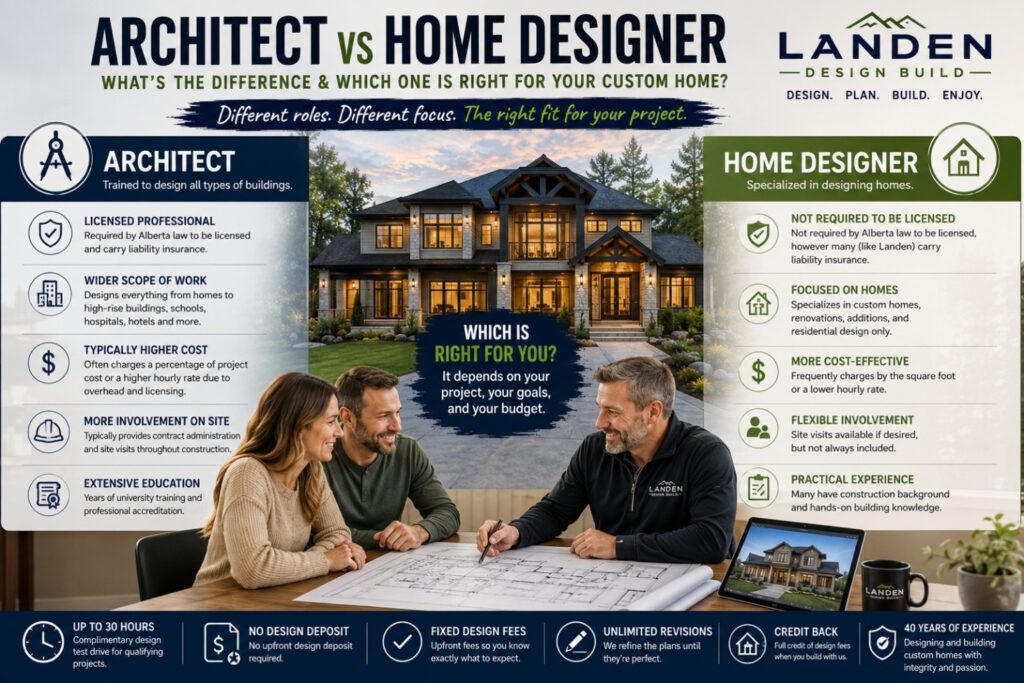
Understanding the Difference
Both architects and residential home designers can create beautiful, functional, and code-compliant homes.
However, there are important differences in education, licensing, project focus, cost, and services provided.
The right choice often depends on the complexity of your project, your budget, and the type of expertise you are looking for.
Licensing and Professional Requirements
In Alberta, architects are regulated professionals who must be licensed and registered to practice architecture.
Architects are also required to carry professional liability insurance and meet ongoing professional development requirements.
Residential home designers are not required to be licensed under the same legislation. However, many professional home designers carry liability insurance and possess extensive education, training, and real-world experience in residential design and construction.
At LANDEN Design Build, we maintain liability insurance and have over 40 years of experience designing and building custom homes.
What Do Architects Design?
Architects are trained to design a wide range of building types, including:
- Custom homes
- Hotels
- Schools
- Shopping centres
- Office buildings
- Hospitals
- Institutional buildings
- Multi-family developments
Many architects work primarily in the commercial, institutional, and multi-family sectors.
A few architects choose to specialize in custom residential design.
What Do Residential Home Designers Design?
Residential home designers focus specifically on homes.
Their work generally includes:
- Custom homes
- Acreage homes
- Estate homes
- Renovations
- Home additions
- Garage suites
- Secondary suites
Because residential designers work exclusively within the housing sector, many develop extensive expertise in residential construction methods, home design trends, family living patterns, and best construction practices that also meet residential building codes.
Cost Considerations
One of the biggest differences between architects and residential designers is often cost.
Architectural firms frequently have higher operating costs due to licensing requirements, professional liability obligations, and the broader scope of services they provide.
Residential home designers generally offer a more cost-effective option for many custom home projects.
Depending on the designer or firm, fees may be based on:
- Hourly rates
- Square footage
- Fixed-price agreements
- Percentage-based design fees
Every firm is different, so it is important to understand exactly what is included before making a decision.
What Services Do Architects Typically Provide?
Architects often provide:
- Site analysis
- Concept design
- Building design
- Construction drawings
- Consultant coordination
- Contract administration
- Construction review services
- Site visits during construction
Many architects remain involved throughout construction to help ensure that the project is being built in accordance with their design documents.
What Services Do Residential Designers Typically Provide?
Residential home designers often provide:
- Home planning and space planning
- Concept development
- Construction drawings
- Permit-ready plans
- 3-D renderings
- Virtual tours
- Design revisions
- Construction consultation
Some residential designers, such as LANDEN Design Build, also offer complete Design-Build services where the same company designs and builds the home.
This creates a single point of accountability throughout the project.
Engineering Requirements
Many custom homes require some level of structural engineering review.
The extent of engineering required depends on:
- The complexity of the design
- Municipal requirements
- Structural spans
- Roof systems
- Foundation design
- Special architectural features
Whether you work with an architect or residential designer, engineering requirements are typically determined by the project itself rather than the title of the designer.
Education and Experience
Architects complete extensive university education and professional training before becoming licensed.
Residential designers come from a variety of educational and professional backgrounds.
Many highly qualified residential designers hold credentials such as:
- Architectural Technologies diplomas
- Architectural drafting certifications
- Building technologies training
- Construction management education
- Structural design training
Just as importantly, many residential designers have extensive hands-on construction experience.
The LANDEN Design Build Advantage
At LANDEN Design Build, founder Greg Genereux combines both design and construction experience.
Greg earned his Architectural Technologist Diploma from SAIT and has additional education in:
- Land Planning and Zoning
- Structural Design
- Construction Technology
In addition, Greg holds Journeyman Carpenter and Cabinetmaker credentials and has spent more than four decades designing and building custom homes.
Combined with his design team, Greg has been involved in the design and construction of well over 1,000 custom homes.
Looking for the Best of Both Worlds?
There is also a third option that many custom home clients may not realize exists.
At LANDEN Design Build, we regularly collaborate with architect Michael Koerner and other design professionals when a project would benefit from additional architectural involvement.
This approach can provide many of the advantages of working with an architect while helping clients avoid some of the higher costs often associated with engaging a full architectural firm from the beginning to the end of the design process.
In many cases, LANDEN’s in-house design team completes the majority of the planning, drafting, budgeting, and 3-D rendering work. This allows clients to benefit from a highly efficient residential design process while keeping costs under control.
Where additional architectural input is desired, Michael can become jointly involved in several ways, including:
- Design review and architectural consultation
- Contemporary and modern home design inspiration
- Architectural plan assessment
- Review of final construction drawings
- Architectural certification and stamping where appropriate
- Periodic site inspections during construction
- Verification that the home is being constructed in accordance with the approved plans
This hybrid approach gives clients access to both practical residential design expertise and professional architectural oversight.
The result is often a level of service that falls somewhere between a traditional residential home designer and a full architectural firm—providing excellent value for clients who want additional architectural involvement without incurring the cost of a full architect-led design process.
For some projects, LANDEN’s in-house design team is the ideal solution. For others, incorporating architectural review and certification may provide additional comfort and confidence.
Our goal is to help each client choose the design approach that best fits their project, budget, and personal preferences.
Another way to look at the design process:
| Option | Best For | Relative Cost |
| LANDEN In-House Design Team | Most custom homes and acreage homes | $ |
| LANDEN + Architect Review & Certification | Clients wanting architect involvement at a lower cost | $$ |
| Full Architectural Firm | Complex or architect-led projects | $$$ |
So Which Is Better?
The honest answer is:
Neither is automatically better.
Both architects and residential home designers can create exceptional homes.
The better question is:
Which professional is the best fit for your project?
For highly specialized or complex projects, an architect may be the ideal choice.
For many custom homes and acreage homes, an experienced residential home designer can provide exceptional value, specialized residential expertise, and a more cost-effective design process.
The most important factors are:
- Experience
- Qualifications
- Design ability
- Communication
- References
- Understanding of your goals
One Final Question to Ask
When interviewing designers, ask:
“Will the same company that designs my home also build it?”
A true Design-Build company with an in-house design team offers significant advantages:
- Better communication
- Fewer surprises
- Improved budgeting
- Greater accountability
- Smoother construction
At LANDEN Design Build, we have over 40 years of experience in both home design and custom home construction.
We also offer:
- No upfront design deposit
- Up to 30 hours of complimentary preliminary CAD design and 3-D rendering for qualifying projects, we call this a FREE design test drive!
- Fixed design fees established upfront
- Unlimited reasonable revisions
- Payment only when plans are 100% complete
Our goal is simple:
To help clients design and build their dream home with less risk, greater transparency, and complete confidence.