
Building a custom home? Before you compare prices, check references or sign a contract, here are some important questions that could save you thousands of dollars — and a great deal of frustration.
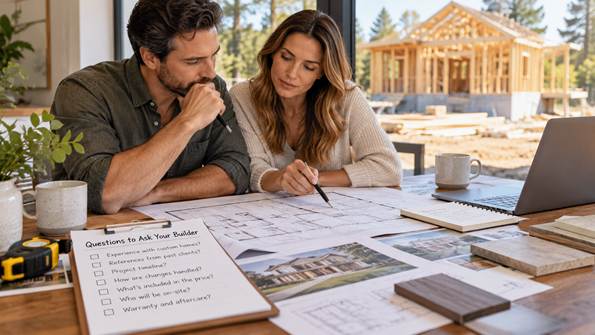
Building a new custom home is likely one of the largest financial investments you will ever make.
Naturally, most homeowners begin by researching custom home builders, reviewing websites, studying photographs of completed homes, and requesting prices.
Those are all sensible starting points.
However, choosing the right custom home builder involves much more than finding attractive home designs or comparing construction quotes.
Some of the most important questions you can ask a builder have little to do with the finished homes displayed on their website.
How does the builder treat their trades and suppliers? Do they pay their bills on time? How do they make their money? Can you see the actual construction costs? Are you required to pay a large deposit before any work begins?
And perhaps most importantly:
Does the builder have a system specifically designed to reduce your financial risk?
Here are 12 questions every homeowner should consider before choosing a custom home builder.
1. Will the Builder Give You Their Complete Trade and Supplier List?
This may be one of the most valuable questions you can ask — and surprisingly few homeowners ever think to ask it.
Most builders should be happy to provide references from satisfied homeowners.
But what about the people who actually build their houses?
We’re talking about the framing crews, electricians, plumbers, heating contractors, concrete contractors, roofers, drywallers, cabinet suppliers and building material companies.
These people work with the builder regularly. They often have a much better understanding of how the company operates behind the scenes.
Ask your prospective builder for a list of the trades and suppliers they regularly use.
Then contact a few of them independently.
Ask questions such as:
- How long have you worked with this builder?
- Do you enjoy working on their projects?
- Are their jobs well-organized and properly supervised?
- Are their plans and specifications clear?
- Do they provide reasonable construction schedules?
- Do they deal fairly with problems?
- Most importantly, does the builder pay you on time?
- Would you recommend this builder to a friend or family member?
Why This Matters
A builder who maintains long-term, respectful relationships with trades and suppliers has an important advantage.
Experienced subcontractors who enjoy working with a builder are often more willing to cooperate, communicate and help resolve unexpected problems.
On the other hand, a builder with a history of payment disputes or poorly managed projects may struggle to maintain reliable trade relationships.
This can affect scheduling, workmanship, pricing and the overall building experience.
Of course, one unhappy subcontractor does not necessarily indicate a bad builder. Look for consistent patterns across several independent conversations.
A Simple Rule Worth Remembering
Happy trades build better homes.
Some established custom home builders, including Calgary-area builder LANDEN Design Build, encourage prospective clients to contact their trades and suppliers as part of the builder-selection process.
It’s a level of transparency worth asking about.
2. Are You Shopping So Many Builders That You Risk Getting the “Go-Away Price”?
Most homeowners assume that approaching as many builders as possible will produce the most competitive construction price.
But there can be a downside to shopping too many builders.
Within the construction industry, there’s an expression known as the “go-away price.”
So what exactly is it?
Imagine a builder who is already extremely busy, has more work than they can comfortably handle, or has decided that a particular project isn’t a good fit.
Rather than declining to quote, the builder may submit a price considerably higher than they would normally charge.
If the homeowner accepts the inflated price, the builder may feel the additional profit justifies taking on the project.
If the homeowner declines, the builder hasn’t lost a project they particularly wanted.
Either way, the builder isn’t especially disappointed.
Why Would Shopping Too Many Builders Make This More Likely?
Preparing a proper custom home quotation takes considerable time.
A builder may need to review architectural drawings, obtain trade quotations, investigate site conditions and analyze dozens of construction specifications.
If a builder discovers that they’re competing against eight or ten other companies, they may decide that the chances of securing the project don’t justify the estimating effort.
Some builders will simply decline to quote. Others may respond with a less competitive price.
A high quotation isn’t automatically a go-away price. It could reflect legitimate differences in specifications, site assumptions, workload, risk allowances or construction methods.
Nevertheless, homeowners should understand that more quotations don’t always produce better information.
A Better Approach
Rather than asking ten builders to prepare full quotations, consider carefully qualifying two or three serious candidates first.
Interview them. Check their references. Review their building processes and fee structures.
Then select a smaller group of builders who are genuinely interested in your project and capable of producing a meaningful, comparable estimate.
LANDEN DESIGN EXAMPLE
Some custom builders offer preliminary budgeting and design assistance before requesting the client’s commitment to a full construction tender.
For example, LANDEN Design Build offers qualifying clients a complimentary preliminary design program, allowing them to explore their home design before advancing to more detailed construction pricing.
The principle is simple: qualify the builder before asking the builder to price the house.
3. Does the Builder Offer a Design Test Drive Before Asking You to Commit?
Would you purchase an expensive new vehicle without taking it for a test drive?
Probably not!
Yet many homeowners commit thousands of dollars to architectural design before having a clear understanding of what their proposed home will look like.
Traditionally, the homeowner may be asked to sign a design agreement and pay a substantial deposit before receiving any meaningful drawings or visualizations.
But it doesn’t necessarily have to work that way.
Ask This Question
“Can I explore my preliminary home design before committing to a full paid design contract?”
Some builders offer complimentary initial consultations or basic concept sketches.
A smaller number provide more substantial preliminary design services.
For example, LANDEN Design Build offers qualifying clients its Free 30-Hour Design Test Drive, which can include preliminary CAD floor plans, exterior design concepts and full-colour 3-D renderings.
The purpose is to help homeowners determine whether the design direction suits their lifestyle, building site and approximate budget before committing to paid construction drawings.
Eligibility restrictions apply, and preliminary designs remain subject to the builder’s intellectual-property terms.
The lesson for homeowners is to find out exactly what design services are included before you’re asked to commit financially.
4. How Much Money Does the Builder Require Upfront?
This is one of the most important financial questions in the entire builder-selection process.
Some builders require significant deposits before starting design or construction.
A deposit is not automatically unreasonable. There may be legitimate reasons for advance payments, particularly where customized materials must be ordered or professional services are being retained.
However, homeowners should understand exactly what they’re paying for and how their money is protected.
Ask the builder:
- How much is the initial deposit?
- What work will be completed in exchange for that deposit?
- Is any portion refundable?
- What happens if the project does not proceed?
- Are additional deposits required before construction?
- How are deposits credited against completed work?
- What protections apply if the builder becomes unable to complete the project?
An Alternative Worth Investigating
Some custom home builders have developed payment structures that reduce or eliminate upfront deposits.
For example, LANDEN Design Build offers qualifying clients preliminary design services without an upfront deposit.
Under its stated design and project management model, agreed design fees become payable when the contracted design work is completed, while construction management fees are tied to completed project milestones.
Not every builder offers this arrangement, and specific contractual terms matter.
The important point is that homeowners should compare payment structures, not simply accept large upfront deposits as an unavoidable part of custom home construction.
5. How Does the Builder Actually Make Their Money?
This is a question homeowners should never be embarrassed to ask.
There are several common ways builders charge for custom homes.
Fixed-Price Construction
The builder agrees to deliver a defined home for an agreed price, subject to the contract’s exclusions, allowances and change provisions.
The builder is responsible for managing the construction costs within the agreed terms.
However, homeowners may have limited visibility into the underlying trade and supplier prices.
Cost-Plus Construction
The homeowner pays the actual eligible construction costs plus an agreed builder fee or percentage.
This can provide transparency, but homeowners should understand whether the builder’s compensation increases as the total construction cost increases.
Fixed-Fee Project Management
Under this arrangement, the builder and homeowner establish an agreed project management fee based on the defined project scope and budget.
The fee is fixed under the contract rather than automatically increasing whenever construction costs or homeowner selections increase.
This can help separate the builder’s compensation from the homeowner’s decisions to purchase more expensive finishes or upgrades.
An Important Question
“If I decide to upgrade my countertops by $20,000, does your builder’s fee increase?”
The answer may reveal a great deal about the builder’s compensation structure.
Some builders, including LANDEN Design Build, offer a fixed-fee project management arrangement under which covered upgrades do not automatically increase the builder’s agreed management fee.
Whatever approach you choose, ask for a written explanation of exactly how the builder is paid and under what circumstances their fees can change.
6. Will You See the Actual Trade and Supplier Prices?
Transparency is another important consideration.
Some homeowners receive a single construction price with little visibility into what the individual trades and materials actually cost.
Other builders operate using an open-book system.
Under a properly documented open-book arrangement, homeowners can review relevant trade quotations, supplier invoices, allowances and project expenses.
Questions Worth Asking
- Can I review the actual quotations from subcontractors?
- Will I see supplier invoices?
- Are trade or supplier discounts passed on to me?
- Are there additional markups on upgrades or changes?
- What expenses are included in the builder’s fee?
- How will I approve budget changes?
Why This Matters
Imagine selecting a more expensive countertop, flooring product or plumbing fixture.
Wouldn’t you prefer to understand the actual price difference before approving the change?
Some custom builders, such as LANDEN Design Build, offer open-book project management with visibility into trade and supplier costs and pass-through pricing under their agreed contracts.
Transparency doesn’t guarantee the lowest construction cost, but it can give homeowners a clearer understanding of where their money is going.
7. Can You Pay Trades and Suppliers Directly?
This is another question rarely discussed when selecting a custom home builder.
Under many traditional construction arrangements, the homeowner pays the builder, and the builder then pays the trades and suppliers.
That arrangement can work very well when properly managed.
However, homeowners should understand the potential consequences if a subcontractor or supplier is not paid.
Depending on the circumstances, unpaid parties may have rights to register builders’ liens against the property, which can create a lien domino effect, that could eventually become a real horror story.
An Alternative Payment Structure
Some builders use a project management model that allows homeowners to pay approved subcontractor and supplier invoices directly.
This can provide greater visibility into which invoices have been paid and reduce reliance on funds passing through the builder.
For example, LANDEN Design Build encourages direct payment of trades and suppliers under its agreed project management arrangements.
Direct payments do not eliminate every lien risk. Proper documentation, and compliance with Alberta’s construction-payment legislation remain important.
But this is another example of why homeowners should ask detailed questions about a builder’s payment system before signing a contract.
8. Does the Builder Have a Risk Reduction Program?
Every builder will tell you they want the project to go smoothly.
But what specific procedures do they have to reduce the homeowner’s financial risk?
This question deserves careful attention.
A well-organized custom home building process should address matters such as:
- Preliminary budgeting before major design commitments.
- Clear construction specifications and allowances.
- Written contracts and fee structures.
- Documented change-order procedures.
- Construction milestone payments.
- Trade and supplier payment verification.
- Appropriate insurance and new home warranty coverage.
- Project cost reporting and transparency.
- A clearly defined construction schedule.
- Procedures for dealing with delays and unexpected expenses.
Ask for More Than Promises
A builder saying, “Don’t worry, we’ll look after everything,” isn’t the same as having a documented system.
Ask the builder to show you how their process works.
For example, LANDEN Design Build has developed a Risk Reduction Program featuring complimentary preliminary design for qualifying projects, no upfront design or construction deposits under its stated model, fixed fees, open-book cost reporting and direct trade payment arrangements.
Homeowners should ask any builder offering such a program to explain the specific protections, limitations and contractual terms.
The best risk reduction measures are the ones documented in writing — not simply promised during a sales presentation.
9. Does the Builder Have Experience With Your Type of Property?
Not every custom home builder specializes in the same type of construction.
Building a home on a fully serviced city lot can be substantially different from building a custom acreage home.
Acreage construction may involve:
- Private water wells.
- Septic systems.
- Long utility service runs.
- Extended driveways and access roads.
- Complex grading and drainage requirements.
- Rural municipal approvals.
- Unusual soil or foundation conditions.
- Limited access for construction equipment.
These issues can materially affect the overall project budget.
Ask the Builder
“How many homes have you built on properties similar to mine?”
If you’re planning a custom acreage home in Foothills County, Okotoks, Diamond Valley or the surrounding Calgary region, look for a builder with demonstrated experience in rural residential development.
For example, LANDEN Design Build specializes in custom acreage homes, combining residential design and construction experience with knowledge of rural property development.
The important lesson is that relevant experience matters more than a builder’s total number of completed projects alone.
10. Does the Builder Have a Proven Track Record and Satisfied Clients?
Now we come to the more traditional checks.
They’re still very important.
Ask for several past client references, preferably from projects similar in size, complexity and budget to your proposed home.
And don’t just ask whether the homeowners liked their finished house.
Ask:
- Was the builder responsive during construction?
- Were unexpected costs explained clearly?
- Were changes approved before work proceeded?
- Did the project generally follow the agreed schedule?
- Were deficiencies addressed promptly?
- Was the builder still responsive after possession?
- Would you hire the same builder again?
Whenever possible, arrange to see examples of completed homes.
Photographs are useful, but an in-person visit can reveal details of workmanship that may not be apparent online.
Check Independent Sources
Review the builder’s Google reviews and Better Business Bureau profile.
Look for patterns rather than relying on a single positive or negative review.
A builder with a long history will occasionally encounter disagreements. What matters is how professionally those issues were handled.
11. Is the Builder Properly Licensed, Insured and Covered by New Home Warranty?
In Alberta, most professional builders constructing new homes must hold a valid residential builder licence, and applicable new homes require statutory warranty coverage, subject to legislated exceptions.
Homeowners should independently verify the builder’s licence status through Alberta’s Residential Protection Program public registry.
They should also confirm the warranty provider and proposed home’s coverage.
Ask for evidence of:
- Valid Alberta residential builder licensing.
- New home warranty registration or eligibility for your project.
- Appropriate commercial general liability insurance.
- WCB-Alberta coverage or clearance, where applicable.
- Course-of-construction insurance arrangements.
- Any additional coverage required by the construction lender.
A company’s business registration, licence and warranty information are not interchangeable. Check each separately.
These are basic qualification requirements — not optional extras.
12. Who Will Actually Design, Supervise and Build Your Home?
Before signing with a custom home builder, find out who will be responsible for your project once the sales process is complete.
Will you work directly with an experienced designer?
Who prepares the construction drawings?
Who coordinates the trades?
Who supervises construction?
How frequently will you receive updates?
Can you visit your construction site?
And will the person who made the promises during the sales presentation still be involved after construction begins?
Why Experience Matters
A builder with an experienced in-house design team, established trade relationships and knowledgeable construction supervision may be better positioned to identify problems before they become expensive changes.
Some companies, including LANDEN Design Build, maintain in-house architectural design and drafting capabilities, framing and finishing crews, and cabinet and millwork services.
This level of integration isn’t essential for every project, but homeowners should understand which services are performed directly and which are subcontracted.
The real objective is accountability.
You should know who’s responsible for each stage of your project and who to contact when questions arise.
Final Thoughts: The Best Builder Isn’t Necessarily the Cheapest Builder
Choosing the right custom home builder should never be reduced to one question:
“Who’s going to build my house for the lowest price?”
A low quote can become an expensive mistake if it excludes important work, relies on unrealistic allowances or comes from a builder who cannot manage the project effectively.
Conversely, a higher quote doesn’t necessarily mean you’re receiving better value.
The best approach is to compare builders based on their experience, integrity, trade relationships, financial transparency, construction management systems and willingness to stand behind their work.
Before choosing your builder, remember these five particularly important questions:
- Will you let me speak directly with your trades and suppliers — and ask whether you pay them on time?
- Can I explore my home design before committing substantial money?
- How much money do you require upfront, and what protections do I have?
- How do you earn your fees, and can I see the actual construction costs?
- What specific systems do you use to reduce my financial risk?
A builder who welcomes these questions and provides clear, documented answers deserves serious consideration.
A Final Piece of Advice
Don’t just interview the builder. Interview the people who work for the builder, understand how the builder gets paid, and investigate what happens to your money throughout construction.
Those answers may tell you more about the company than any sales brochure ever could.
About LANDEN Design Build
LANDEN Design Build is a Calgary-area custom home and acreage home builder offering integrated design and construction services. Its Risk Reduction Program includes a complimentary 30-Hour Design Test Drive for qualifying homeowners, fixed-fee project management, open-book pricing, no upfront deposits under its stated program, and direct trade and supplier payment arrangements.
Learn more at www.landendevelopment.com.
Program availability and contract terms apply. This article provides general consumer education and is not legal or financial advice.