

A practical guide to reducing financial, design and construction risk when building a custom home.
| A Better Way to Design. A Better Way to Build. A Better Way to Reduce Risk.™ |
Building a custom home should be exciting. But for many families, excitement is accompanied by uncertainty: Will the budget get out of control? What happens to my deposit? How do I know the trades are being paid? What if the plans are finished and I discover I cannot afford to build the home? What if every change becomes another markup?
The LANDEN Risk Reduction Program™ was created around those questions. This e-book explains where common risks enter a custom-home project, how better information can reduce them, and why LANDEN structured its design and construction process differently.
| IMPORTANT Risk reduction is not risk elimination. No builder can promise that every construction, financial, schedule, legal, market or site risk will disappear. The objective is to identify foreseeable risks early, reduce unnecessary exposure and improve the quality of decisions as better information becomes available. |
About LANDEN Design Build
LANDEN is a Calgary-area custom-home design build and project-management builder with more than 40 years of experience in custom residential design and construction. Landen’s founder Greg Genereux has designed and built more than1,000 homes.
Our work includes custom homes, acreage homes, renovations, cabinetry and millwork, with an emphasis on detailed planning, transparent budgeting and practical constructability.
This guide describes the philosophy behind our risk reduction process.
NORE: It is not legal, tax, insurance or financial advice. Clients should obtain independent professional advice where appropriate.
TABLE OF CONTENTS
Introduction: Why Risk Reduction Matters 5
1. What Is Risk Reduction? 6
2. Why We Created the Program 7
3. Risk Starts Before Construction 8
4. Set a Realistic Budget First 9
5. Start With the Wish List 10
6. The 30-Hour Design Test Drive 11
7. No Upfront Design Deposit 13
8. Budget → Design → Re-Budget 14
9. Design With Construction Experience 15
10. Full Tendering Before Construction 16
11. No Large Upfront Construction Deposit 17
12. A Fixed Project Management Fee 18
13. Transparency, Direct Payments & Visibility 19
14. Changes Should Be Decisions, Not Surprises 20
15. Acreage Risk Starts Before the Land Purchase 21
16. Scheduling Is Also Risk Management 22
17. Experienced Trades Reduce Risk 23
18. What the Program Does Not Promise 24
19. The LANDEN Risk Reduction Journey™ 25
20. Questions to Ask Any Builder 26
Closing: Why We Built the System 27
CHAPTER INTRO
Why Risk Reduction Matters
Building a custom home may be one of the largest financial commitments a family ever makes. It also involves a long chain of decisions made before and during construction. Each decision can affect cost, schedule, quality and the client’s confidence in the process.
The usual industry conversation often starts with a price-per-square-foot number. We believe a more useful conversation starts with a different question: How does the process protect the client when something does not go exactly according to plan?
The answer is not one clause in a contract or one promise from a salesperson. Risk reduction is a system. It begins before the first drawing is produced and continues through budgeting, design, tendering, construction, possession and after-service.
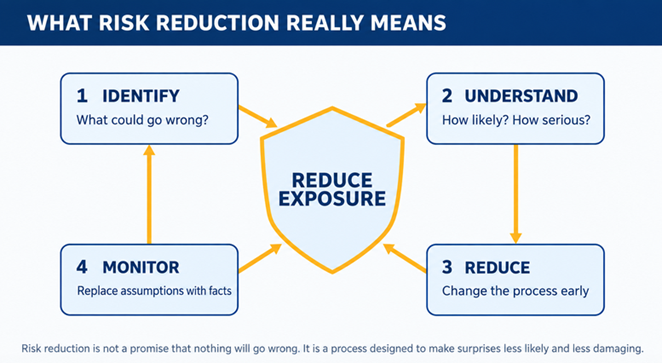
Figure 1 — LANDEN’s working definition of risk reduction: identify, understand, reduce and monitor.
| THE CENTRAL IDEA The earlier a risk is identified, the more choices the client usually has — and the less expensive the project is likely to be. |
CHAPTER 1
What Is Risk Reduction?
Reducing exposure before a problem becomes expensive
Risk reduction is the process of identifying something that could go wrong, understanding the possible consequence, and changing the process so the risk is less likely to occur or less damaging if it does occur.
That sounds simple, but custom-home projects contain many different types of risk. There is design risk: the home plans may be too skinny in design details, where trades and sub-contractors later say “looks good on paper but how do we build this”? Translation “This will cost you extra”!
There is also the design risk of designing a home that simply will not fit within the client’s budget! Or may not be designed for highest and best use of your building site, or you lifestyle or real needs.
There is financial risk: allowances or assumptions may be too optimistic.
There is payment risk: the client may not know who has actually been paid.
There is schedule risk: a premature possession promise can create additional costs when the job takes longer than expected. Where the client may literally be on the street, or need to live in a hotel if they can’t find temporary accommodation.
There is site risk, especially on acreage properties, where servicing and access can change a project construction budget dramatically.
A responsible system does not pretend these risks do not exist. It makes them visible earlier.
| RISK REDUCTION IS DIFFERENT FROM A GUARANTEE A guarantee says a specific result will occur. Risk reduction says the process is intentionally designed to reduce unnecessary risk exposure, protect your investment, and make better decisions possible. |
CHAPTER 2
Why We Created the Program
The homeowner fears that shaped our process
The origins of the LANDEN Risk Reduction Program™ go back roughly three decades. We wanted to understand what prospective homeowners were actually afraid of when considering a new home.
We commissioned two separate anonymous focus groups, each with approximately 15 prospective new-home clients. The groups were conducted separately. Participants were able to speak freely, while I listened from behind one-way glass rather than sitting in the room influencing the discussion.
The two groups identified remarkably similar concerns. Clients worried about prices escalating, large deposits, hidden markups, liens, unexplained changes, long schedules, quality problems and losing control of their money. Beneath almost every concern was the same question: How do I protect myself?
That changed the way we looked at the business. Instead of asking only how to convince clients to hire us, we started asking how to redesign the process so clients had fewer reasons to be afraid in the first place.
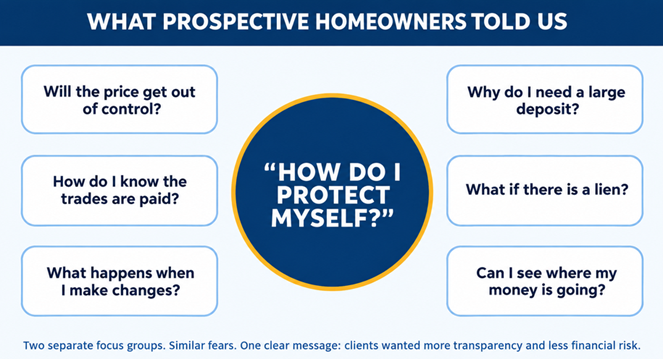
Figure 2 — The concerns were expressed in different ways, but the underlying message was consistent: clients wanted protection, visibility and control.
CHAPTER 3
Risk Starts Before Construction
The cheapest problem to fix is often the one that never reaches the jobsite
Many people think construction risk begins when excavation starts. In reality, some of the largest risks are created months earlier.
Imagine spending thousands of dollars on a custom design, developing the plans for months, falling in love with the home, and only then discovering that the finished design is hundreds of thousands of dollars beyond the intended budget. The builder has not broken ground, but the project already has a major problem.
The same principle applies to site planning, structure, servicing and selections. Decisions made on a screen are comparatively easy to change. The same decisions become progressively more expensive once drawings are engineered, materials are ordered and construction is underway.
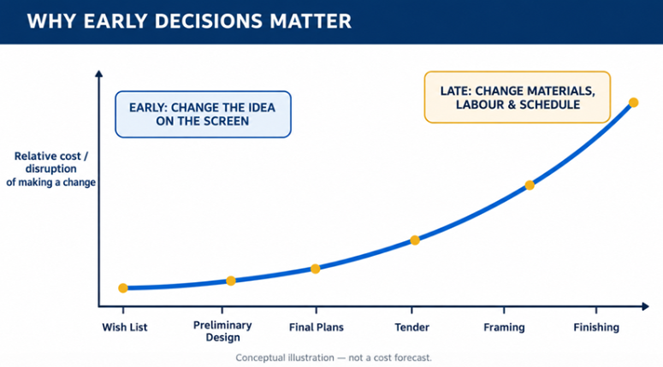
Figure 3 — Conceptual illustration: the cost and disruption of a change generally increase as a project advances.
CHAPTER 4
Set a Realistic Budget First
A budget is not a secret — it is a design parameter
Some clients are reluctant to tell a builder or designer their budget. They may fear that if they reveal a number, the project will somehow grow to consume it.
We understand the concern. But responsible design requires financial boundaries for the same reason it requires property lines, setbacks and ceiling heights. A home intended for one level of investment is designed differently from a home intended for another.
The budget affects square footage, foundation size, roof complexity, glazing, cabinets, bathrooms, mechanical systems, exterior finishes, garage size and site development. The purpose of knowing the budget is not to discover how much can be spent. It is to determine what should be designed.
The first budget will never be perfect. Its job is to provide a realistic starting range and identify obvious conflicts between the wish list and the available investment before those conflicts become expensive.
One free service that Landen offers is a “wish List Budget Assessment” What this involves is having the client fill out a very detailed wish list form that we have developed that is then reviewed and costed out purely based on the wish list without any plans being in place. Landen has developed a priority estimating system specifically designed to help set a realistic budget BEFORE any planning is started!
| A SIMPLE TEST If the proposed home is already pushing beyond the budget at the wish-list stage, adding more detail to the plans will not solve the problem. The design and or specifications needs to change before the drawings are complete, and become even more expensive to revise after the fact. |
CHAPTER 5
Starting With a Detailed Wish List
Turn dreams into measurable priorities
The budget defines the financial boundary. The wish list explains what matters inside that budget boundary.
If we are to be your custom home designer, we want to know upfront your home’s potential target size, number of floors, garage size, basement development size, target size of rooms, such as bedrooms, great rooms, dining areas etc. We also need to know the target number of bathrooms, types of bathrooms, ball park number of windows, rough cabinet’s allowance, appliances allowance, target interior finishes, and exterior materials, outdoor living areas and major mechanical preferences etc.
Because we have found over the last 40+ years that most people dream BIG, and generally have champagne taste that may need to be tamed down a bit to fit the target budget, we also want to know which items are must-haves, which are strong preferences and which are simply nice-to-have ideas.
This wish list does two things. First, it gives our design team a practical brief as a design staring point. Second, it gives the budgeting process something that is somewhat measurable to set a pre-design rough construction budget BEFORE any design work has started. The concept is NOT to design a home that will eventually BLOW UP your budget!
Along with a detailed wish list, we also need as many “ideas” that you can round up, such as internet search ideas and image clippings, along with any rough sketches or rough bubble planning (See also our e-book on bubble planning) All of which help our design team to create a fairly detailed rough budget purely based on a wish list only with no plans being in place.
A wish list should not be a collection of disconnected dreams. It should be a well thought out the first detailed working version of the projects overall scope.
| WISH LIST = FIRST ROUGH BUDGET = PRELIMINARY DESIGN BRIEF The strongest preliminary design starts when the client’s priorities and financial expectations are considered together — not in separate conversations. Done properly this will help to reduce the risk of over designing a home that blows the budget! |
CHAPTER 6
The 30-Hour Design Test Drive
Why commit to a designer before you know how the relationship works?
Most people would not buy an expensive vehicle without taking it for a test drive. Yet custom-home clients are often expected to commit thousands of dollars to design before they know whether the designer understands them, whether the proposed home fits the site or whether the design is heading toward something they can afford.
For qualified projects, LANDEN offers up to 30 hours of preliminary planning and design at no charge. We call it our Design Test Drive.
Depending on the project, that preliminary work can include scaled floor plans, preliminary elevations, colour 3-D views, site considerations, design discussions and an early budget check. At our typical design rate, the 30 hours represents roughly $2,250 of professional design time.
The larger value is not the dollar amount. It is the opportunity for both parties to answer three questions before a major commitment: Is the relationship working? Is the design working? Is the budget working?
See also our Design Test Drive Full Details

The Design Test Drive is the first major client-facing component of the Risk Reduction Program™.
| QUALIFICATION MATTERS Because LANDEN is investing real design time and serious money, a $2,000+ value with any other design firm, the complimentary Design Test Drive is intended for qualified projects within our service area where the client has a building lot or serious site, and an approximate and realistic budget and a developed and detailed wish list. |
CHAPTER 7
No Upfront Design Deposit Required!
Shift the performance obligation toward the designer
If the client decides to proceed beyond the preliminary Design Test Drive, LANDEN establishes the design fee right up-front before continuing. The client knows right up-front what a full set of construction plans will cost with no extras added.
We include a reasonable amount of plan revisions as included in our design fees. Unlike other designers where every plan revision cost EXTRA!
We also include a full 3D rending package, complete with 3D exterior vies, 3D floor fly-over views, and a 3D video walk through of your home before anything is ever built, so you fully understand what you are about to build. Unlike other designers and architects that want to bill you extra for these renderings, we include this as part of our very completive standard design fees
Unlike other designers “skinny plans” our plans are very detailed to way and above the minimum requirement for a building permit. Our plans are designed for trade ease of use, including detailed area take-offs of things like roof, soffit, fascia, gutter and siding areas, this helps eliminate trade guess work!
THE BIG ONE, We do not require any upfront design deposit. The client pays for the agreed plans only when the design work is 100% completed.
This is a deliberate part of the risk-reduction philosophy. Rather than having the client’s money sitting with the designer while the work is still unfinished, Landen’s design team carries the responsibility to perform the agreed work.
The design fee is established in advance, and a reasonable amount of revisions are included within the agreed scope. The objective is to make the design relationship understandable before the client makes the next financial commitment.
| WHAT RISK DOES THIS REDUCE? It reduces the client’s upfront financial exposure during design and keeps LANDEN focused on completing the agreed work before payment is due. Plus our system virtually eliminates design extra billing! |
CHAPTER 8
Budget → Design → Re-Budget
A good estimate should improve as information improves
The rough budget at the beginning of a project is not intended to be the final number. It is a working model built from limited information.
As the design progresses, the information becomes better. Approximate square footage becomes actual square footage. The roof becomes measurable. Exterior walls, windows, cabinetry, bathrooms, flooring and decks become quantities instead of assumptions. Site questions are answered. Specifications become clearer.
The budget should evolve with that information. This is why LANDEN’s process repeatedly returns to the budget rather than treating the first estimate as something carved in stone.
The objective is to replace assumptions with better information before each major commitment.
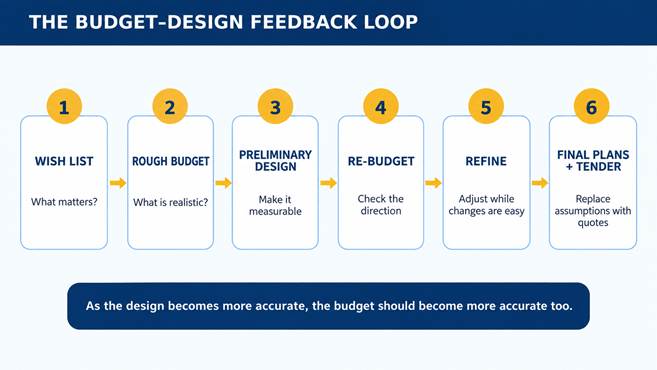
Figure 4 — LANDEN’s preferred feedback loop: each increase in design detail should trigger a better budget check.
| WHY THIS MATTERS A $20,000 problem discovered during preliminary design is a planning decision. The same problem discovered after contracts, engineering and ordering can become a construction problem. |
CHAPTER 9
Design With Construction Experience
A drawing must eventually become a real building
A design can look attractive and still be unnecessarily difficult or expensive to build. Complex rooflines, long structural spans, excessive corners, difficult mechanical routing and awkward relationships between floors can add cost without adding equal value to the homeowner.
LANDEN brings more than four decades of construction experience into the design process. We do not look at a floor plan only as a drawing. We ask how it will be framed, supported, serviced, finished and priced.
That construction perspective can create opportunities to simplify the home while protecting the features the client actually values. The objective is not to strip character from the design. It is to achieve the desired result with fewer avoidable surprises.
| GOOD DESIGN = MORE THAN APPEARANCE For a custom home, good design combines appearance, lifestyle, constructability, site conditions and budget. |
CHAPTER 10
Full Tendering Before Construction
Replace broad allowances with project-specific quotations
Price-per-square-foot numbers are convenient, but custom homes are not actually built or purchased by the square foot. Two homes with the same area can have very different overall costs because of foundations, roof geometry, glazing, kitchens, bathrooms, mechanical systems, exterior materials and specifications.
With the Landen design system we have two stages of tendering, the first stage is at the completed “preliminary plans stage”, meaning plans that are drafted to scale and have enough CAD detail to start a rough preliminary tendering budgets. Keep in mind these are preliminary plans only BEFORE moving the plans onto a full set of “structural plans”. The idea is to first see where the preliminary plan lands with a preliminary tender round, to see if the preliminary plans might need a few revisions or a little tightening up on overall size and specifications.
Once the plans are permit-ready, LANDEN then obtains a very detailed second round of tendered pricing from the trades and suppliers expected to perform the work. This tendering stage replaces many of the preliminary assumptions with actual project-specific quotations, based on the final plans and specifications.
No tender can eliminate every construction variable. But the closer the project is to construction, the less the budget should depend on broad averages and the more it should depend on actual scope and pricing.
| THE GOAL BEFORE CONSTRUCTION Real plans + real quantities + real specifications + real trade quotations = a much stronger basis for the construction decision. |
CHAPTER 11
No Large Upfront Construction Deposit
Tie builder compensation to progress
One of the clearest concerns identified in the original focus groups was the fear of handing a builder a large amount of money before any meaningful construction progress had occurred. With a real fear of “what happens if the builders runs off with MY money, or goes out of business during my build”!
LANDEN’s project-management model does not require any large upfront construction deposit simply to begin managing the project. Our Project Management fee is mutually agreed to up-front and set as a fixed project management fee, and is only invoiced as each pre-agreed construction milestone is completed.
Landen’s philosophy is straightforward: the financial relationship should track actual project progress as closely as practical.
As bonus, our fixed management fee virtually eliminates the risk of a builder trying to upsell you to make EXTRA profit, or make extra profit from you changing your mind during construction, or making extra profit from your upgrades!
The Landen management system does not add EXTRA mark-up to these changes, meaning we have “0” incentive to try and talk you into extras!
| PAY FOR PROGRESS — NOT PROMISES Milestone-based management fees reduce the amount of net builder compensation the client must advance before corresponding work has been achieved. |
CHAPTER 12
A Fixed Project Management Fee
Avoid a fee structure that automatically grows with every upgrade
Under many percentage-based cost-plus arrangements, builder compensation increases as construction cost increases. If the client selects more expensive cabinets, flooring or other upgrades, the builder wants to receive an additional percentage on top of the upgrade.
LANDEN establishes a fixed Project Management fee against the mutually agreed, tender-backed project budget. Once established, Landen’s project management fee remains fixed under the agreed terms rather than automatically increasing every time the client chooses a more expensive component or changes their mind during construction.
We believe this makes the financial relationship clearer. LANDEN knows its compensation is fixed no matter what happens to the hard building cost that may change due to market conditions or client upgrades or project changes. The client knows the project management cost are fixed and knows up-front that Landen has “0” incentive to try and talk the client into unnecessary changes.
Decisions about upgrades can then focus on whether the upgrade or project changes is worth the money to the client rather than how much additional builder mark-up will be added.
In many cases we talk the client out of some changes, simply because they may not have fully thought out the repercussions of the change.
| ALIGNMENT MATTERS A fixed fee structure cannot eliminate every conflict, but it can remove the automatic relationship when “a project costs more to build due to market conditions or even client changes” and “the builder earns more profit due to these cost changes.” With Landen’s approach we have virtually no incentive to try and up-sell you or make your project cost go up. As our management fee is fixed, no matter what the job cost actually come in at! |
CHAPTER 13
Transparency, Direct Payments & Visibility
Know where the money is going
Another concern from the focus groups was simple and important: How do I know the builder actually paid everybody?
Where appropriate within the project-management structure, LANDEN encourages clients to pay trades and suppliers directly. The client can see the invoice, know who is being paid and understand what the payment is for. Builder discounts obtained for the project are passed through to the client.
This does not mean direct payment eliminates every possible construction-lien issue or every legal obligation. It does not. Construction-lien rights and statutory requirements can be complex, and clients should obtain legal advice about their specific project.
The risk-reduction benefit is transparency: the client has much greater visibility into quotations, invoices, payments and changes instead of seeing only one rolled-up number from the builder.
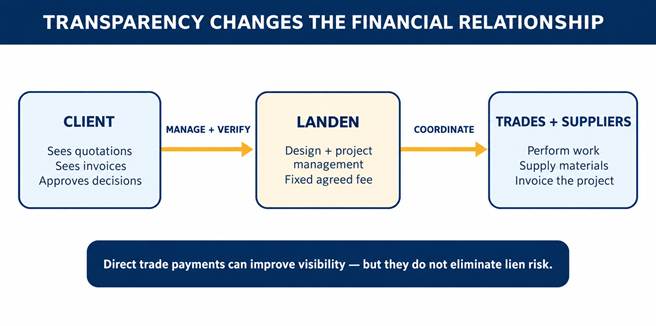
Figure 5 — Transparency is about visibility and accountability, not a promise that statutory construction risks disappear.
| WHY WE PASS THROUGH DISCOUNTS Our agreed Project Management fee is intended to compensate LANDEN for managing the project. Supplier or trade discounts obtained for the job are therefore passed through with no further mark-up, rather than treated as a hidden second profit centre. |
CHAPTER 14
Changes Should Be Decisions, Not Surprises
Make the cost consequence part of the decision
Custom homes changes. Clients see spaces taking shape and think of improvements or changes after construction has started. Or see new products that become unavailable at “home shows”. Site conditions reveal new information. Better ideas may emerge.
The problem is not necessarily that changes occur. The problem is when the financial effect is not understood until much later.
A transparent process tries to make the cost implication part of the decision. If the client understands the cost, the client can choose to proceed, decline the change or offset the additional spending somewhere else.
That is also why a live budget matters during construction. As assumptions are replaced by tendered and actual costs, the budget should continue to show the effect on the projected total as construction proceeds..
| A CHANGE ORDER SHOULD ANSWER FOUR QUESTIONS What changed? Why did it change? What does it cost? What does it do to the overall budget? At Landen we believe that these changes should not ADD extra profit for the builder. The concept is simple, we are being paid a fixed management fee to MANAGE your project, and generally speaking we think the project will take virtually the same amount of time and energy to manage with or without changes and client requested upgrades. |
CHAPTER 15
Acreage Risk Starts Before the Land Purchase
The view can be beautiful while the servicing costs are not
Acreage projects introduce an additional layer of risk because the land itself can create large construction costs.
A property may require a well, water treatment, a cistern, a septic system, long electrical runs, propane or other fuel solutions, a long driveway, extensive grading, tree clearing or drainage work. Slopes can affect foundation design. Road restrictions can affect hauling. Travel distance can affect trade pricing and availability. Municipal requirements can change what is permitted on the site.
That means the purchase price of the land is only part of the equation. Two acreages with similar asking prices can have very different total development costs.
LANDEN therefore encourages clients to investigate buildability before becoming emotionally committed to a property whenever possible.
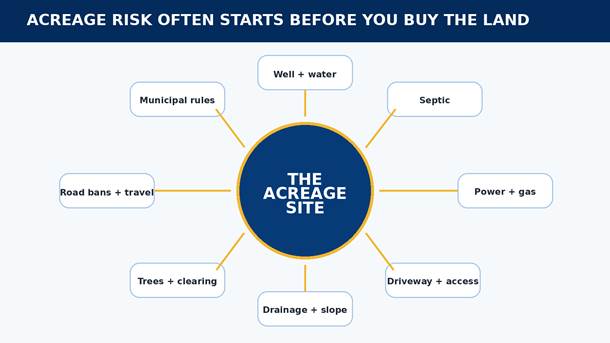
Figure 6 — Acreage due diligence is part of risk reduction because site costs can materially affect the overall project budget.
| BUY THE BUILDABLE PROPERTY — NOT JUST THE VIEW The best acreage decision considers the house, servicing, access, drainage, approvals and site work together. |
CHAPTER 16
Scheduling Is Also Risk Management
Do not create certainty before the project information supports it
Time has a financial consequence. Delays can create additional interest, temporary accommodation costs, storage, disruption and stress.
LANDEN’s typical custom-home build is approximately 9 to 12 months, depending on the project. We also avoid locking in a possession date too early, when too many construction variables still exist.
Once drywall is complete and primed, many of the largest schedule uncertainties are behind the project. At that milestone, we can establish possession with much greater confidence, typically around 90 days later, with a pre-possession walkthrough shortly before handover.
The principle is the same as budgeting: use better information when it becomes available rather than pretending to have certainty before it exists.
| A REALISTIC DATE IS MORE VALUABLE THAN AN EARLY UNMEET DATE Risk reduction means managing expectations with current information, not simply giving the earliest answer a client wants to hear. |
CHAPTER 17
Experienced Trades Reduce Risk
Systems matter — and so do the people doing the work
A detailed plan and a strong budget are important, but someone still has to build the home.
LANDEN has trade and supplier relationships that extend back decades. Long-term relationships do not guarantee that no mistake will ever occur, but they create familiarity with expectations, communication standards, sequencing and quality.
We also believe a healthy payment relationship matters. Trades that know they will be treated fairly and paid promptly for completed work are more likely to prioritize our projects, and solve communicate problems early and remain engaged in finding solutions.
Our philosophy is simple: happy trades generally build better homes.
One thing we do at Landen right upfront BEFORE we ask you to engage us, is provide you with a detailed list of our trades and suppliers for you to fully verify right up front that our trades and suppliers are happy to work for us, and give you a good second reference on top of our great list of happy client reference.
| QUALITY IS A PROCESS Clear plans, experienced trades, realistic schedules, fair payment and active project management all influence the final result. |
CHAPTER 18
What Our Program Does Not Promise
Credibility starts with being clear about the limits
The LANDEN Risk Reduction Program™ does not promise that construction prices can never change, unforeseen site conditions will never occur, schedules will never move, products will never be delayed, clients will never revise their wishes, municipalities will never request changes or trades will never make mistakes.
Those promises would not be realistic.
Instead, our program is a commitment to process. We work to identify foreseeable risks earlier, provide better information as it becomes available, keep the financial relationship transparent, reduce unnecessary upfront financial exposure and deal with problems when they arise.
A strong process cannot remove uncertainty from construction. It can make uncertainty easier to see, understand and manage.
Landen’s goal is to help you save money through out your build process, and make the experience as painless as possible.
You can ask many of our clients are happy to report that the Landen design build process was actually “fun” to build a home, and relatively stress free, check out our Google reviews!
| THE PROMISE IS THE PROCESS Identify early. Budget realistically. Design intelligently. Tender thoroughly. Communicate changes. Keep the client informed. Offer full transparency. |
CHAPTER 19
The LANDEN Risk Reduction Journey™
From the first wish list to after-possession service
Risk reduction works because the individual steps reinforce one another. A realistic wish list helps the preliminary budget. The preliminary budget helps guide the design. The design creates quantities. Quantities improve the estimate. Final plans enable trade tendering. Tendering strengthens the construction budget. Transparent construction replaces assumptions with actual costs.
The result is not a single moment when the project suddenly becomes “safe.” It is a series of better-informed decisions.
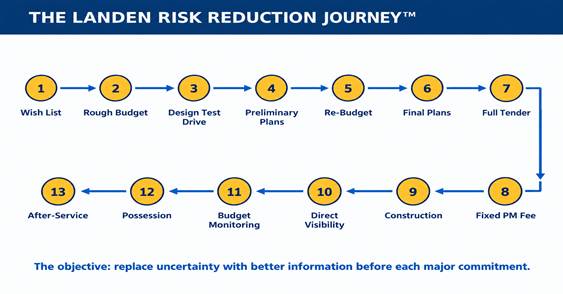
Figure 7 — The LANDEN Risk Reduction Journey™ follows the project from wish list to after-service.
- Wish List — define what the client actually wants.
- Realistic Preliminary Budget — test the wish list against the intended investment.
- 30-Hour Design Test Drive — experience the design process before a major commitment.
- Preliminary Plans — turn ideas into a measurable home.
- Re-Budget — compare the developing design to the intended investment.
- Final Construction Plans — complete the detailed design.
- Full Tender — obtain project-specific trade and supplier pricing.
- Fixed Project Management Fee — establish LANDEN’s compensation before construction.
- Milestone-Based Construction — tie management payments to progress.
- Transparent Cost Visibility — show quotations, invoices and changes.
- Budget Monitoring — replace assumptions with tendered and actual costs.
- Possession Planning — set the final date when schedule information is strong enough.
- After-Service — continue the relationship after the keys are handed over.
CHAPTER 20
Questions to Ask Any Builder
A practical checklist before you sign
A prospective client does not need to understand every technical detail of construction before choosing a builder. But the client should understand the builder’s process.
The following questions are designed to uncover where financial and process risk sits before a contract is signed. There is no single correct answer for every project. The important thing is that the answer is clear.
| QUESTION TO ASK | YES / NO | NOTES | |
| How is the preliminary budget established? | |||
| When is the budget checked against the developing design? | |||
| What happens if the design is over budget? | |||
| How much money is required before design begins? | |||
| How much money is required before construction begins? | |||
| How is the builder compensated? | |||
| Does the builder’s fee automatically increase when construction costs increase? | |||
| Can I see the trade and supplier quotations? | |||
| Can I see the invoices during construction? | |||
| Who receives supplier and trade discounts? | |||
| Can I pay trades or suppliers directly where appropriate? | |||
| How are changes priced and approved? | |||
| How is the current total budget tracked during construction? | |||
| When is the possession date established? | |||
| What happens if a major unforeseen issue appears? | |||
| What warranty and after-possession service are provided? | |||
| Can I speak with past clients and long-term trades? | |||
| ONE QUESTION ABOVE ALL “How does your process protect me if something does not go exactly according to plan?” | |||
CHAPTER CLOSING
Why We Built the System
More information. More transparency. Fewer unnecessary risks.
Those original focus groups taught us something important. People were not simply afraid that a custom home might be expensive. They were afraid of losing control — of the budget, their money, the design, the changes, the schedule and sometimes the relationship with the builder itself.
We listened, and over the years we continued to change the way LANDEN designs, budgets and manages custom homes.
Some of the tools have changed dramatically. CAD replaced hand drafting. 3-D visualization became part of the design process. Estimating systems became more sophisticated. Tendering and communication became faster. But the objective has remained remarkably consistent: give the client better information, more transparency and fewer unnecessary reasons to take financial risk.
That is the purpose of the LANDEN Risk Reduction Program™.
| A Better Way to Design. A Better Way to Build. A Better Way to Reduce Risk.™ |

LANDEN Design Build
IMPORTANT INFORMATION
This e-book is provided for general educational and marketing purposes and describes LANDEN Design Build’s approach to custom-home design, budgeting and project management. It is not a guarantee of project cost, schedule, legal outcome or construction result.
Construction projects involve risks that may be outside a builder’s control, including market conditions, weather, site conditions, municipal requirements, product availability, trade availability and owner-requested changes.
References to direct trade or supplier payments are intended to describe a transparency practice. They do not eliminate statutory lien rights, holdback requirements or other legal obligations that may apply to a particular project. Clients should obtain independent legal, financial, insurance, tax, engineering and other professional advice as appropriate. The LANDEN Risk Reduction Program™ and associated materials are proprietary to LANDEN Design Build / Landen Development Inc. All rights reserved.