A Better Way to Build a Custom Home—By Reducing Builder Risks Before They Become Problems
Where the LANDEN Risk Reduction System™ Came From
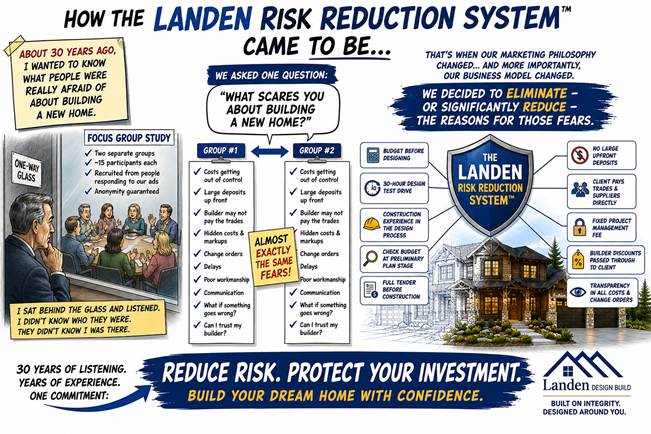
The LANDEN Risk Reduction System didn’t begin as a marketing slogan. It actually started roughly 30 years ago with two commissioned focus group studies.
At the time, I wanted to better understand what prospective custom-home clients were really thinking—not what builders thought clients were thinking, but what homeowners themselves were worried about when considering building a new custom home.
So I hired an independent consultant company to conduct two separate focus group studies.
They recruited participants from people who had responded to advertising seeking individuals interested in discussing the custom-home-building experience. The participants were anonymous to me, and were told that no one would follow up later and try to sell them anything. I didn’t know who they were, and they weren’t sitting across a table talking directly to me or trying to tell a builder what they thought a builder wanted to hear.
Instead, I sat behind a one-way glass and simply watched and listened.
And I learned something that changed the way I looked at our business.
The study was conducted using two completely separate groups, each consisting of approximately 15 participants. The participants in one group didn’t know what the other group had discussed. In fact, they didn’t even know there was another group being tested.
Both groups were essentially asked the same fundamental question:
“What scares you about building a new home?”
We didn’t start by telling them what builders thought the problems were. We wanted them to tell us. And they sure did!
- They talked about their fears of costs getting out of control.
- They worried about paying large amounts of deposit money upfront.
- They worried about whether the builder would actually pay the trades and suppliers.
- They worried about hidden costs.
- They worried about excessive mark-up on change orders.
- They worried about whether the house they designed would ultimately fit their budget.
- They worried about understanding plans, or if the home would turn out like they thought.
- They worried about poor workmanship, and builders cutting corners.
- They worried about delays.
- They worried about transparent communication.
- They worried about what would happen if something went wrong.
- They worried about whether they could actually trust their builder.
- They worried about a builder running off with their money and leaving them with an unfinished home, with a bunch of trade liens on their home.
- All in all everyone worried about all the horror stories that the heard from other friends and family members that had gone through a really bad experience with a builder!
But what surprised me most wasn’t any single concern.
It was what happened when we compared the two groups.
Despite being completely independent of one another, the two groups identified almost exactly the same fears.
That got my attention. These weren’t isolated complaints from one or two unhappy homeowners. We were hearing remarkably similar concerns from two independent groups of prospective custom-home clients.
And I remember thinking:
“What if, instead of trying to convince people that they shouldn’t be afraid of these things, we changed the way we did business to eliminate—or at least substantially reduce—the reasons for those fears in the first place”?
That question ultimately changed our marketing philosophy. But more importantly, it changed Landen’s business model.
Don’t Sell Against the Fear. Remove the Reason for the Fear.
That became Landen’s philosophy. If clients were afraid of putting down a large construction deposit:
We would eliminate the large upfront deposit all together.
If they were afraid the builder might run off with their money and fail to pay the trades:
The client could pay trades and suppliers directly.
If they were worried about hidden builder markups:
We would show them all the trade and supplier quotes right-up-front before a final sign-off.
And we would also show them the actual invoices.
If they were worried that every upgrade would make the builder more money:
We would establish our Project Management fee upfront and keep it fixed.
If they were worried about spending thousands designing a house they couldn’t afford:
We would establish a rough construction budget before we even started designing anything.
And then:
In order to eliminate the fear of clients worrying about paying a designer thousands of dollars before knowing whether that designer understood them:
We would offer to qualified clients a FREE design test-drive of our process. Offering up to30 hours of real CAD and 3D rendering
We would also offer to check the budget again at the preliminary-plan stage before spending substantially more money completing the plans.
This would include Landen re-visiting the take-off based on the CAD work done to that point, having our trades and suppliers do a preliminary review of the preliminary plans and updating the original rough construction budget that was originally based only on the “wish-list” and Landen’s building site assessment. This way the client would get a much better idea of where we expected final building cost to land “before” moving forward with final structural plans, which would allow the client to make any plan changes to help keep the overall project on budget.
All of these services offered to help eliminate the fear of clients worrying about paying a designer thousands of dollars before knowing whether that designer understood them:
One by one, we began looking at all the fears those homeowners had identified and asking:
“What can we change about our process to reduce that risk?”
We thought many risks could be virtually eliminated. We could substantially reduce others. But some risks are simply inherent in custom construction and can never honestly be eliminated completely.
But that wasn’t the point.
Landen’s objective was to stop asking the homeowner to accept unnecessary risk simply because “that’s the way the construction industry has always done it.”
And over the years, those individual changes evolved into what we at Landen now call:
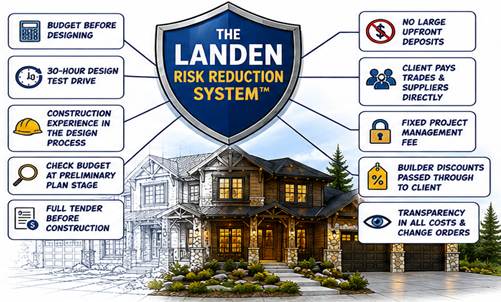
The LANDEN Risk Reduction System™
Most people thinking about building a custom home, start to think about the exciting things.
- The floor plan.
- The kitchen.
- The views.
- The finishes.
And dream of finally creating a home designed specifically around their family. But, what they usually don’t think about or fully understand is all risk involved with building a home.
Yet building a custom home may be one of the largest financial commitments a family will ever make. Depending on the project, hundreds of thousands—or even millions—of dollars can move through a construction project over a relatively short period of time.
So before asking:
“Who can build my dream home?” or “Who has the best price” perhaps there is a better question worth asking:
“Who has a system designed to reduce most of my risk while building it?”
That question is at the heart of what we at Landen call the:
LANDEN Risk Reduction System™
It isn’t one gimmick or an added contractual clause. It’s a series of procedures we’ve developed from more than 40 years of real-world design and construction experience, all based around one simple philosophy:
Identify risk early. Try to eliminate risk as much as possible. Reduce risk wherever possible. And don’t ask the client to take risks that aren’t necessary.
Risk #1: Spending Thousands on Plans Before Knowing Whether You Can Afford the Home
This is one of the first risks many custom-home clients encounter. You hire a designer. Pay a deposit. Spend months developing plans. Fall in love with the house. Complete the engineering. Then send everything to builders and finally ask:
“Okay—what will these plans cost to build?”
In our option that is putting the cart before the horse!
At LANDEN, we prefer to begin with the client’s wish list and create a detailed rough budget based on that wish list, along with doing a building site review before any substantial design work begins.
Using our proprietary preliminary estimating system and historical construction costs, we can develop a surprisingly detailed rough construction budget based initially only on the client’s wish list and a site assessment alone.
That gives us an early opportunity to ask:
- Which items are must-haves?
- Which are would-like-to-haves?
- Where is the money most likely to go?
- Which decisions could significantly affect the budget?
Only then do we begin developing the home plan.
RISK REDUCTION #1: Budget before starting-design planning.
Risk #2: Paying a Large Design Deposit Before You Know Whether the Designer Is Right for You
Hiring a custom-home designer can involve a surprising amount of trust. You may have seen their convincing portfolio. You may like their previous work. But can they understand your ideas? Can you communicate well together? Will they listen?
And can they turn what is in your head into a home that works?
Traditionally, you may have to sign an agreement and pay a substantial design deposit before seeing any design work getting done for you!
LANDEN takes a different approach.
Qualifying clients can experience our no charge 30-Hour Design Test Drive, providing up to 30 hours of preliminary CAD design and 3-D rendering work before needing to making a major financial commitment to the design process. If for any reason you are not happy with Landen’s design test drive, you can walk away and owe us nothing. (Ask us for more details)
We believe you should have an opportunity to experience how we work before being asked to fully commit. There is nothing to sign or commit to, however we do have some project qualifying details, ask us for more information.
RISK REDUCTION #2: Test-drive the design relationship first.
Risk #3: Designing a Home Without Enough Construction Knowledge at the Table
A home can look terrific on paper and still be unnecessarily difficult—or expensive—to build. A seemingly simple design decision can affect:
- Foundation.
- Floor framing.
- Structural beams.
- Roof design.
- Mechanical routing.
- Plumbing.
- Exterior elevations.
And ultimately: The end Construction cost.
That’s why LANDEN believes good custom-home design requires more than drawing experience. It requires hammer-in-hand construction experience. Our Design-Build approach brings 40+ years of construction knowledge into the design process from the beginning.
Kind of like 3D chess, as we’re designing, we’re also thinking:
- How will we build this?
- What will it probably cost?
- Is there a simpler structural solution?
- Is there a less expensive way to achieve the same result?
- Are we still within the client’s budget?
RISK REDUCTION #3: Design with construction in mind from Day One.
Risk #4: Waiting Until the Plans Are Finished to Discover the Real Build Cost
We don’t believe budgeting should happen only once. LANDEN’s process creates several budget checkpoints.
Wish List → Preliminary Rough Budget
Before significant design work.
Preliminary Plans → Updated Construction Budget
Before investing heavily in final structural drawings and engineering.
Completed Construction Plans → Full Tender
Before construction begins.
If something needs to change, we’d rather discover it at the preliminary-plan stage than after thousands of dollars have been spent completing plans and engineering.
Or worse—after construction has begun.
RISK REDUCTION #4: Check the budget while changes are still inexpensive.
“The best time to discover a $50,000 problem is when it can still be fixed with a pencil or a few key strokes”! Greg Genereux
Risk #5: Paying a Builder a Large Upfront Construction Deposit
This is one of the areas where LANDEN’s system is fundamentally different from most other builders. Many construction agreements require a substantial 10-20% deposit before construction ever begins.
LANDEN’s Project Management approach does not require any large upfront construction deposit simply for us to begin managing your project. Our management fees are directly tied to the construction process and invoiced as agreed milestones are completed, with pre agreed to amounts, that will not change or increase as the project progresses.
Why should a client unnecessarily put a large amount of money at risk before corresponding work has been performed? Landen’ system has you pay for things once they are in place and only as and when milestones have been achieved.
RISK REDUCTION #5: No large upfront construction deposit.
Risk #6: Paying the Builder—and Hoping the Builder Pays Everyone Else
This may be one of the least understood risks in residential construction. A homeowner can pay their builder and naturally assume:
“I’ve paid the builder, therefore everybody working on my home has been paid.”
Unfortunately, those aren’t necessarily the same thing. If a contractor experiences financial trouble, trades and suppliers may still be owed money. And unpaid parties may have statutory lien rights, subject to Alberta law.
That’s why LANDEN encourages a fundamentally different approach:
Where practical, we encourage our clients to pay trades and suppliers directly.
- You can see the actual invoice.
- You know who is being paid.
- You know how much is being paid.
- And you know for sure bills are paid!
This means money doesn’t need to unnecessarily pass through a builder’s bank account first.
RISK REDUCTION #6: Know where your construction dollars are going.
Risk #7: Builder Markups Increasing Every Time You Upgrade
Consider a traditional percentage-based cost-plus arrangement. Suppose the builder charges 15%. You decide to spend another $20,000 upgrading your cabinetry. The builder’s fee for that upgrade increases by $3,000. Same thing if you upgrade the windows? The builder’s fee increases once more. Upgrade the flooring? Fee increases again, and so forth. The more you spend, the more the builder earns on your upgrades.
There isn’t necessarily anything improper about this percentage-based construction management, in fact it is quite a common business model. But there is an obvious question about incentive alignment.
LANDEN uses a totally different approach.
Once we’ve established the mutually agreed construction budget, our Project Management fee is then based on that budget and is then fixed. Meaning no matter what you upgrade or if market condition change, Landen does not make a single penny more on your upgrades or unforeseen cost increased.
If you subsequently decide to upgrade something, Landen’s fee doesn’t automatically increase simply because you chose a more expensive product.
RISK REDUCTION #7: Our fee isn’t designed to reward us for encouraging you to spend more.
Risk #8: Hidden Builder Discounts and Markups
Trades and suppliers often provide preferred pricing to builders with whom they have long-standing relationships. So who gets that benefit?
With LANDEN:
ALL Builder discounts are passed through to the client.
Our compensation is the agreed to and fixed Project Management fee.
We’re not trying to create a second hidden profit centre by marking up every trade invoice or keeping supplier discounts that should benefit the project.
RISK REDUCTION #8: Transparency means seeing the real numbers.
Risk #9: Change Orders Becoming a Profit Centre
Changes during construction happen. Clients change their minds. Products become unavailable. Site conditions create surprises.
But one of the dangers of certain fixed-price contracts is that once construction begins, the homeowner has very little negotiating leverage over changes.
The original contract may have been competitively priced. The change order isn’t necessarily subject to the same competition.
LANDEN’s transparent Project Management structure reduces that problem because clients can see the underlying trade and supplier costs for any upgrades or changes, and pay only the builders hard cost of upgrades and changes, with no additional builder mark-up!
A $10,000 change shouldn’t mysteriously become $15,000 simply because construction has already started and the homeowner has nowhere else to go.
RISK REDUCTION #9: Changes remain transparent too.
Risk #10: The Designer, Engineer and Builder Pointing Fingers at One Another
You’ve probably heard some version of this:
- Designer: “That’s a construction issue.”
- Builder: “That’s how the designer drew it.”
- Engineer: “The plans need to change.”
And the homeowner is standing in the middle asking:
“I don’t care whose problem it is. Who is going to fix it—and how much is it going to cost me?”
This is another reason LANDEN believes so strongly in Design-Build all under one roof.
Design, budgeting and construction are treated as parts of one connected process, rather than unrelated services handed from one company to another.
RISK REDUCTION #10: Fewer gaps between design and construction responsibility.
Risk Reduction Doesn’t Mean Risk Elimination
This is important. Anyone who promises a completely risk-free custom-home construction project isn’t being realistic.
- Weather happens.
- Material prices change.
- Hidden site conditions occur.
- Products are delayed.
- Clients change their minds.
- Renovations and existing properties can reveal surprises.
- And no process can eliminate every construction risk.
The objective is not to pretend risk doesn’t exist.
The objective is to identify the risks we can control and systematically reduce them. That distinction matters.
The LANDEN Risk Reduction System™
Put the pieces together and you get a very different construction philosophy:
- Budget before substantial design.
- Test-drive the design process before making a major commitment.
- Bring construction experience into design from Day One.
- Recheck costs at the preliminary-plan stage.
- Tender completed plans before construction.
- Avoid unnecessary large upfront deposits.
- Encourage direct payment to trades and suppliers.
- Use a fixed Project Management fee.
- Pass builder discounts through to the client.
- Keep construction costs transparent.
- Coordinate design and construction under one team.
None of those ideas by itself eliminates all the risks of building a custom home.
Together, they create a system designed around reducing them.
Before You Choose a Builder, Ask a Different Question
Most homeowners understandably ask:
“What’s your price?”
We think there’s a better question:
“How are you protecting my investment and reducing my risk?”
Ask your prospective builder:
- Who holds my money?
- Who pays the trades?
- Can I see the actual invoices?
- Do I receive your supplier discounts?
- Does your fee increase when I upgrade?
- How much do I have to pay before construction starts?
- When is the construction budget verified?
- Who designed the plans?
- Does the designer have actual construction experience?
- Who is responsible when the plans and construction details don’t agree?
Those questions may tell you considerably more about the builder than the number at the bottom of the first quotation.
A Better Way to Build
At LANDEN Design Build, we’ve spent more than 40 years learning that building a great custom home isn’t only about what happens on the construction site.
It’s also about creating a process that protects the client before, during and after construction.
That’s why we developed the:
LANDEN Risk Reduction System™
Better information. Better transparency. Better alignment. = Less risk.
Because when you’re investing hundreds of thousands—or potentially millions—of dollars into your new home, the process used to protect your investment should be every bit as carefully designed as the home itself.
“The LANDEN Risk Reduction System™”